


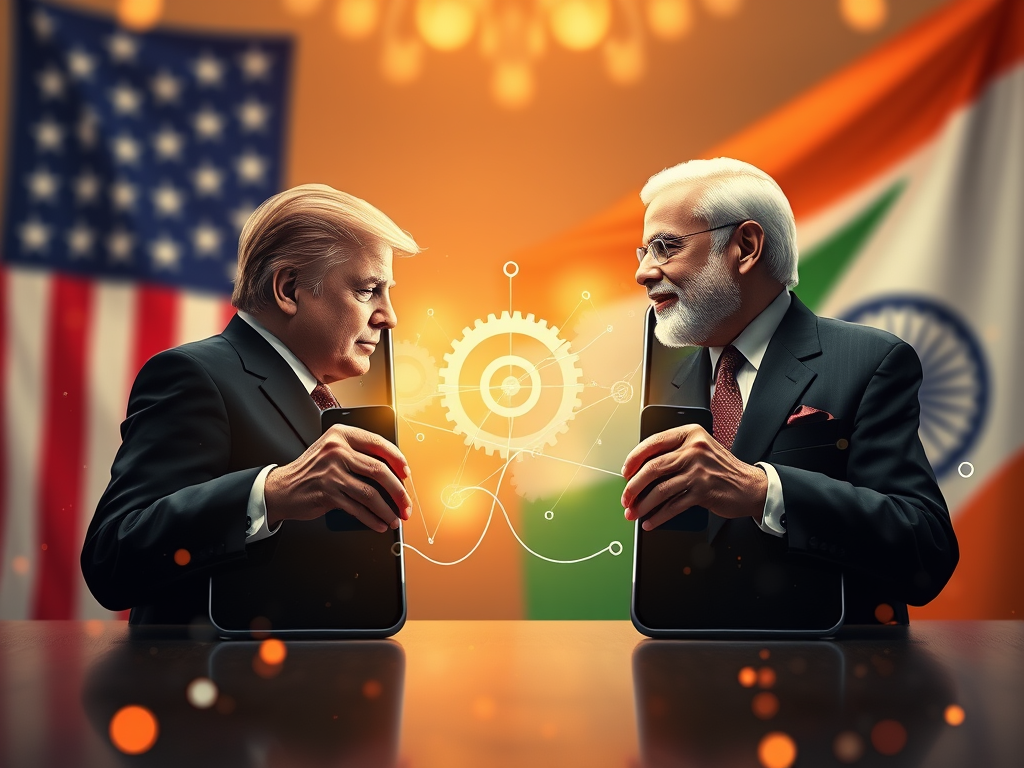
Trump calls Modi and Slashes Tariff 50 to just 18
Much Awaited Indo-US Trade Deal sealed after Trump calls Modi, US slashes Tariff from 50 to just 18%; stock market to skyrocket
Dr Indukant Dixit
Washingoton DC/New Delhi, February 02 (CMC) Breaking the ice and sending ripples through global financial markets and redefining the geopolitical landscape of the Indo-Pacific US President Donald Trump called Prime Minister Narendra Modi for about half an hour this evening (IST) finally sealing the much awaited Indo-US Trade Deal slashing the US Tariff from huge 50 percent to just 18 percent with immediate effect, even less than the new found friends of US, Pakistan (19) Bangladesh (20) Indonesia (19 percent) and other South East Asian Countries and Canada (35) China (30), hailed by the Prime Minister Narendra Modi as the ‘deal between world’s two largest democracies’.
In a move that has sent ripples through global financial markets and redefined the geopolitical landscape of the Indo-Pacific, the United States and India have officially sealed a landmark trade agreement. The “ice-breaking” moment occurred this evening during a high-stakes, 30-minute telephonic conversation between US President Donald Trump and Indian Prime Minister Narendra Modi when the US President Trump called the Prime Minister Narendra Modi. The Indian Stock Market is expected to skyrocket on Tuesday, however the details of the deal shall be unfolding in couple of days, claimed the US Ambassador to India Sergio Gor, who joined here on January 14, 2026.
The centerpiece of the deal is a dramatic reduction in US import tariffs on Indian goods, which have been slashed from a prohibitive 50 percent to a highly competitive 18 percent. This move effectively grants India “Most Favored Democracy” status in all but name, positioning the South Asian giant as the primary alternative to the traditional manufacturing hubs of Southeast Asia and China.
The Phone Call That Changed the Calculus
Sources within the White House and the Prime Minister’s Office (PMO) describe the conversation as “extraordinarily cordial yet business-like.” The call, initiated by President Trump, was the culmination of months of back-channel diplomacy led by trade representatives who had reached a stalemate over “reciprocal taxes.”
During the call, President Trump reportedly emphasized his commitment to the “America First” agenda while recognizing that a strong, economically vibrant India is essential for regional stability. Prime Minister Modi, in turn, framed the deal as a natural progression for the “world’s two largest democracies,” a sentiment he later echoed on social media.
Strategic Tariff Positioning: India Leads the Pack
The reduction to 18 percent is not just a mathematical adjustment; it is a profound strategic signal. By setting the tariff at 18 percent, the US has placed India in a superior trading position compared to its regional neighbors and traditional rivals:
India: 18%
Pakistan: 19%
Indonesia: 19%
Bangladesh: 20%
China: 30%
Canada: 35% (in specific dairy and industrial sectors)
Economic analysts point out that by making Indian exports cheaper than those from Pakistan and Bangladesh, the US is incentivizing a massive shift in supply chains—particularly in textiles, pharmaceuticals, and light engineering—toward Indian shores.
Reactions of the Leaders: The Social Media Surge
Immediately following the call, both leaders took to their respective social media platforms to announce the breakthrough to a global audience.
President Donald Trump posted on X (formerly Twitter):
“Just had a GREAT call with my friend Prime Minister Narendra Modi. We have finished a HUGE Trade Deal! US Tariffs on Indian goods are coming down from 50% to just 18%. This is great for American consumers and even better for the Great Indian Workers. We are making things together again. MAGA meets Make in India!”
Prime Minister Narendra Modi responded with a post emphasizing the democratic bond:
“Excellent conversation with my friend @realDonaldTrump. Today marks a new chapter in the Indo-US partnership. Slashing tariffs to 18% will create millions of jobs and strengthen our MSMEs. This is a deal between the world’s two largest democracies for the global good. Win-win for both nations!
Economic Data: Why the 18% Figure Matters
To understand the magnitude of this deal, one must look at the current trade trajectory. In 2024-25, bilateral trade between India and the US crossed $190 billion. However, the growth had been hampered by retaliatory tariffs on steel, aluminum, and agricultural products.
1. The Textile and Apparel Sector: With a 20% tariff, Bangladesh had a slight edge over India in the US garment market. At 18%, India now gains a significant price advantage, which experts predict could lead to a 25% surge in Indian textile exports within the first 12 months.
2. Pharmaceuticals: India provides 40% of the generic drugs consumed in the US. The tariff reduction will lower healthcare costs for American citizens while boosting the margins of Indian pharma giants based in Hyderabad and Ahmedabad.
3. The “China Plus One” Strategy: With China’s tariffs remaining at a stiff 30%, the 12-point percentage gap created today makes India the most attractive destination for US companies looking to relocate their manufacturing bases outside of the Red Dragon’s influence.
Job Creation and the ‘Democracy Dividend’
Beyond the numbers, the deal is being hailed as the “Democracy Dividend.” PM Modi’s appreciation of the deal as a pact between the two largest democracies highlights a shift from purely transactional trade to “values-based trade.”
Wall Street reacted positively to the news, with stocks of American companies heavily invested in India—such as Apple, Google, and Walmart—showing an immediate uptick. In India, the Nifty and Sensex are expected to open at record highs on Tuesday, driven by the export-oriented sectors.
The Road Ahead
While the tariff slash is immediate, the deal also includes a roadmap for easing H-1B visa norms for Indian tech professionals in exchange for greater access for US dairy and poultry products into the Indian market.
“This is the deal of the decade,” says Dr. Arindam Ghosh, a leading international trade economist. “By undercutting the tariff rates of even the ASEAN countries, the US has effectively bet on India as its primary economic partner in the 21st century. The ’50 to 18′ jump is a massive victory for Indian diplomacy.”
As the world watches the realignment of these two economic titans, one thing is certain: the “frozen era” of trade protectionism between New Delhi and Washington has officially ended, replaced by a 30-minute phone call and an 18 percent reality.